

It is in our power to have no opinion about a thing, and not to be disturbed in our soul; for things themselves have no natural power to form our judgements.
Marcus Aurelius, Meditations, Book VI, Chapter 52
In recent years—perhaps since 2018 onwards—I have noticed that ‘loyalty tests’ have become increasingly common in some corners of the arts and academia. Activists advance a radical proposition, and assert that any person who does not agree entirely with that proposition is morally suspect or even downright sinister. They simultaneously assert that “silence is violence” and that those who do not speak up in agreement can be presumed to belong to the morally suspect category. Disagreement, of course, is also impossible.
In this way, an individual is loyalty-tested. It’s a zero sum game. Stay silent and you are morally suspect; speak up loudly and you are morally acceptable. There is no middle ground or nuance or ability to have a debate.

Loyalty tests have a particular purchase in academia, because of how academics are assessed and promoted. Success in academia is achieved by publishing important works that are frequently cited by other academics, and obtaining government grants for one’s work. If an academic is sidelined in their particular field, then the academic will be less likely to be invited to conferences, their works will be less likely to pass peer review in journals, they will not be published or cited, and they will not receive government grants. Success in academia is highly dependent upon the opinions of one’s peers.
Consequently, peer pressure can be intense. This is the case particularly when there are demands to publicly agree to certain propositions and it appears that everyone else in the field agrees with those propositions. If “silence is violence”, it might not be enough to keep one’s head down and stay silent, even if the issue is entirely irrelevant to the particular field, or only tangentially relevant.
I resent loyalty tests intensely. I like to be able to think calmly about things, to come to my own views in my own time, without peer pressure, and I like to be able to choose whether or not to speak about my views publicly, and to select the details.
I do not subscribe to one big theory which immediately provides me with the purportedly correct and just answer to every problem in the world. I have to think my thoughts through to the end. As a lawyer and academic who studies the court’s responses to disputes between private individuals, I know that real life is messy, and just decisions are not always clear or easy.
I have been thinking about this after Associate Professor Matthew Champion won the Dan David prize for excellence in History for his work on medieval and early modern concepts of time. I am a fan of Associate Professor Champion’s work, and I continue to be interested in these areas of study. It gave me great joy to hear of this.
As someone with an enduring interest in history, I knew that the Dan David prize was prestigious. I will be honest, I had never thought about where the late Dan David came from, or what his beliefs were. It turns out that he was a Romanian Holocaust survivor and Zionist who eventually settled in Israel. The Dan David foundation in Lichtenstein has not said much about the current conflict in Gaza. Of course, that is a problem in the current environment. Anything or anyone which has a connection to Israel in any way is immediately subjected to a loyalty test by activists. Does the person or organisation publicly abjure Israel in every way? If not, they are morally suspect and complicit in genocide.
Consequently, many academics signed a petition in Overland Journal, calling upon Associate Professor Champion to boycott the prize. I am glad Associate Professor Champion rejected the calls, and that our Interim Vice Chancellor, Glyn Davis, spoke out in support of him.
Before you start accusing me of being a shill for Israel—because people really do suffer from severe amygdala hijack when this issue is mentioned—let me run a hypothetical scenario past you. Let’s say this prize were instead from a Palestinian donor who wished to reward academics for excellence in History, and he had believed in the establishment of a Palestinian state before his death. Let’s also say that the organisation had not said much about the current conflict in Gaza, nor used the word “terrorism” about 7 October 2023. Imagine that Jewish organisations and activists protested the foundation’s failure to unequivocally condemn Hamas, alleged that the foundation is complicit in terrorism, and noted that no Jewish scholars have received the prize. They demanded that the recipient reject the prize, asserting that it is suspect. However, there is no evidence that the foundation has in fact done anything to harm Israeli or Jewish people, or positively supported terrorism or the death of innocent people. Moreover, it has supported a wide range of work entirely unrelated to the conflict.
If you argue that it’s okay when “your side” does this, because you are morally right or particularly oppressed, but it’s illegitimate and unfair when the “other side” does it, then you need to take a good hard look at yourself. I regard these scenarios as equivalent. This reflects my commitment to the rule of law.
In either scenario, the prize becomes tainted by the polarising demands of loyalty tests. It does not matter that the donor may have had complex nuanced views on the conflict in the region.1 It does not matter that the purpose of the prize has nothing to do with the current conflict. It does not matter that the recipient’s work also has nothing to do with this conflict, nor that the work may be excellent and worthy of support. It does not matter that the foundation may have stayed silent simply it wants to talk about things to do with its core function (supporting the study of history) rather than being constantly pulled back to a conflict about which it can do nothing.
I suggest in this post that when we feel pressured to comply with loyalty tests in academia, we should resist. We do not have to have an opinion on absolutely every conflict or issue in the world, and people cannot demand of us that we must agree with them entirely. We have freedom of conscience to come to our own beliefs in our own time, and to choose when and how to speak about those views. This is particularly the case when the issue is something over which we do not have much control, and/or involves people who are far away.
I do not have any control over the outcome of the long-running conflict between Israel and Palestine. Pressuring another academic to reject a prize will not have any effect upon the outcome of the conflict, or stop innocent people from dying. It does create an atmosphere where people may feel unable to express nuanced views, because they will potentially lose the support of their colleagues. Frankly, I detected an unpleasant bullying aspect to the Overland petition demanding that Associate Professor Champion reject the Dan David prize: “Agree with us, or else you will lose the support of colleagues, which we know well is necessary to succeed in academia.” I would say the same if a similar petition had been signed in relation to a hypothetical prize founded by a Palestinian donor. Rule of law, remember?
It is also important to allow people not to have a view, particularly when they have no connection to or engagement with an issue or place. Marcus Aurelius was a wise man. He understood that there are limits to what we can control, and the further away events get from our immediate sphere of influence or knowledge, the more likely it is that we might make mistakes.
There’s a Christian version too—the Serenity Prayer:
God, grant me the serenity to accept the things I cannot change,
Courage to change the things I can,
And the wisdom to know the difference.
I cannot affect the outcome of a long-running and complex global conflict. I can control the way in which I treat my students and colleagues, and try to accommodate the fact that we have a diverse staff and student body, with diverse beliefs and perspectives. I can teach the subjects which are directly relevant to my expertise in as balanced a way as possible, noting where there are different views. I can give students the space to make up their own minds on issues, and try to ensure that they do not feel pressured to adopt my views without thinking about them carefully.
There may also be an ideological component to this. I discovered (via Lorenzo Warby) that studies have shown that people with progressive values care more about the universal and distant, and less about the particular and local.2
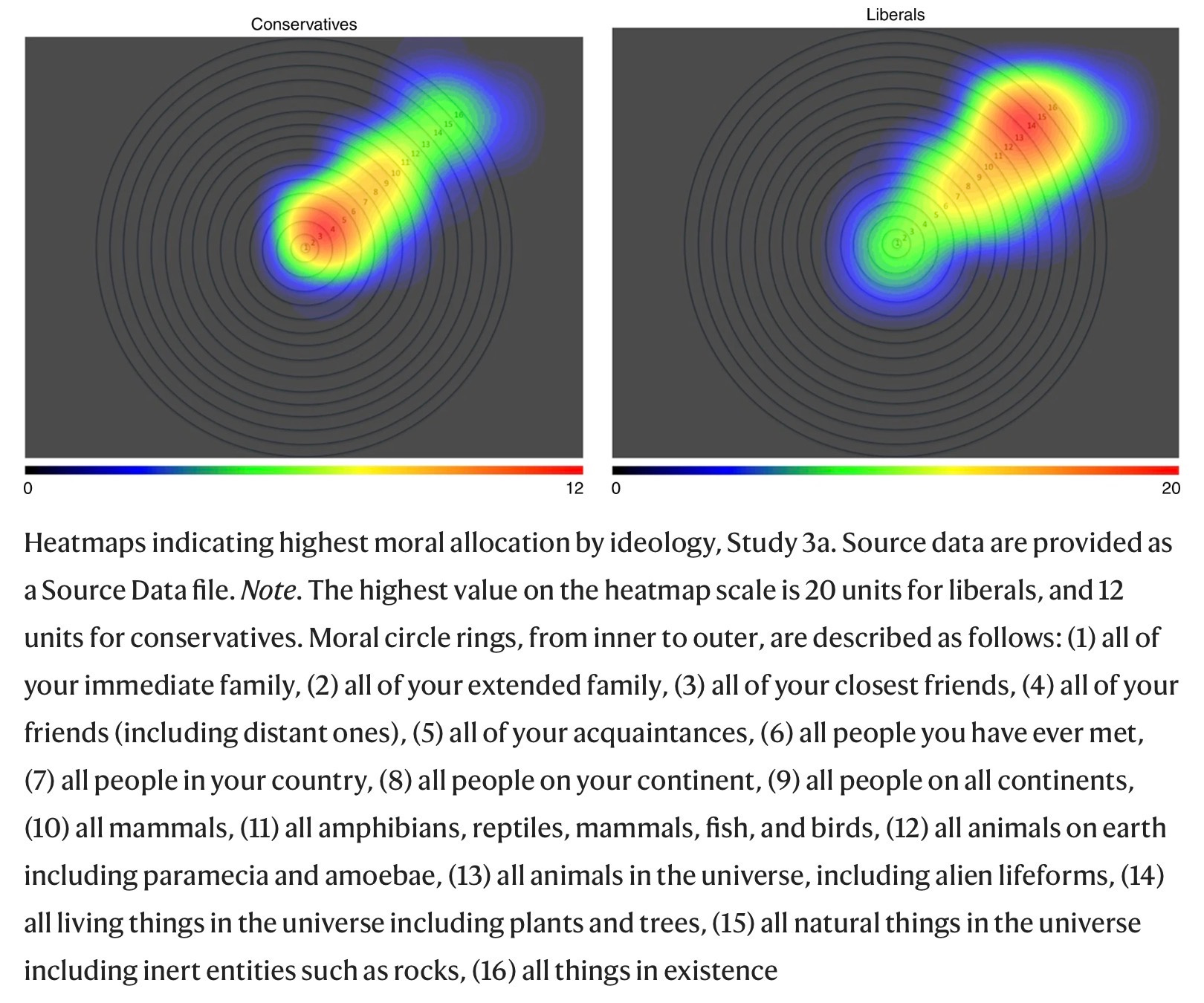
It may be that my determination to focus on the local shows I am becoming more conservative as I age. However, I have found that if I expand my care to encompass everyone and everything, I become anxious and depressed, because obviously I cannot control what happens to the entire world. Hence, I have increasingly taken a more Stoic approach to life, to preserve my mental equilibrium.
It is similarly important to allow people to stay silent about their views, particularly if their views are not directly relevant to the topics they are discussing or teaching. There are times when silence is appropriate. When I was young, I used to think it was very important to be entirely honest. As you can imagine, this got me into trouble sometimes.
Let’s take a trivial example where I might have preferred that other people remain silent. Years ago, I received the results of a Student Experience Survey. For whatever reason, several students decided to take issue with my clothing. I had only just finished my PhD and, frankly, we had struggled to afford groceries at times, let alone fashionable clothing, as I had two very young children and a mortgage. A PhD stipend is fine for a single person, but it did not cover those kinds of costs.
Was it true that my clothing was not fashionable, and that my shoes were a little shabby? Yes, it was.
Was it relevant in any way to the quality of my teaching? No, it was not.
Would the same students have objected if I had graded their assignments with the following feedback: “This paper was great and deserved an H2A, but I hate your haircut, so you get H3”? Yes, they would, quite correctly.
Did this feedback improve my teaching? No. But as you can tell from my account above, the feedback still stings, and that’s over a decade later. I could never wear those shoes again.
The point is, it is not always necessary to tell someone exactly what you think, and sometimes it is actually counterproductive to civil and constructive dialogue.
I’ve noticed that the notion of ‘Bring Your Whole Self to Work’ seems to have suffered from concept creep. The original idea was that LGBT+ people should be able to speak about their partners and not suffer prejudice at work. Obviously, I support that. However, some people seem to have re-interpreted it as, “I should be entitled to share all my views and every detail of my private life with everyone, and if you disagree with this, or object to my views in any way, you are a bigoted fascist and/or anti-free-speech.”
I promise, no one wants to see my Whole Self, and nor should anyone have to suffer Unfiltered Katy. I am allowed to keep some parts of my life private. I am also allowed to keep some of my beliefs and views to myself, no matter what others demand of me. The liberal value of tolerance requires it, no less: we hold back from showing prejudice towards someone and tolerate their beliefs or characteristics, even if we privately dislike them, but this only works if it is mutual tolerance.
In fact, it’s pivotal that I filter what I say when I deal with colleagues or students. I might not like a student’s haircut3—to take the trivial example above—but I absolutely should not judge their work on the basis of it, or discriminate against them in my dealings with them. It is professional to keep my views to myself, particularly if they are not relevant to the subject matter at hand.
I believe that academia must step back from ‘loyalty tests’ on any issue. Yes, if I accept a prize, and a colleague objects to the provider of the money, the colleague should be able to express this view to me or others (hopefully politely). No, a large band of academics should not attempt to pressure another academic with an open letter, no matter what the issue is. I have decided that I will never sign open letters again. Most of the time, on the rare occasions when I have done so, I have not agreed entirely with the contents, and I’ve regretted signing it later.
I also think that academic institutions must step back from imposing political views on people, and practice institutional neutrality. We must allow academics and students to come to their own views, and give people the space to reason things out for themselves. That is part of the intellectual learning process. I don’t agree with everything I thought when I was nineteen years old—far from it—but luckily I was given the space to think things through.
Frankly, to use social pressure rather than rational argument to try to force someone to publicly agree with you is an implicit admission of lack of confidence in your arguments. If we cannot reason in a respectful and scholarly way, but instead, we have to try to pressure others into agreeing with us, what use are we as academics?
I honestly don’t know what Dan David’s views were and I do not care.
A. Waytz, R. Iyer, R., L. Young et al, ‘Ideological differences in the expanse of the moral circle’ (2019) Nat Commun 10, 4389. https://doi.org/10.1038/s41467-019-12227-0
Actually, I’m unlikely to notice. My husband and I buck the stereotypes. He remembers anniversaries and notices haircuts. I’m thinking about various other issues (eg, trusts and remedies)! I don’t have brain space to notice those things!
Well put. An equivalent piece of childish gibberish is "your silence speaks volumes". No, it doesn't. It might mean I haven't thought about it, don't think I have opinions worth sharing, suspect the loaded way something has been phrased, or (increasingly these days) suspect the person of sheer bad faith. Or, I might not be able to squash my thought into 280 characters.
Yes, agree with all of that. And Student Experience Surveys are an abomination.