

I recently had a flying visit to London, for a conference at UCL for the 200th anniversary of Chitty on Contracts, and the launch of the online edition of Damages for Breach of Contract along with my friend and colleague Adam Kramer’s book, The Law of Contract Damages. Given that my book also deals with UK contract damages, it was an honour to have a launch in the UK. It’s the first time I’ve been able to get to the United Kingdom since 2013. I lived in England for a third of my childhood, although I have no recent UK ancestry—the most “recent” of my British ancestors to come to Australia were Scots from Colonsay, after the Highland Clearances. So it was very nice to go back, albeit far too briefly.
Apologies to those friends and family whom I did not have time to see. Next time.
What does a law professor do when she touches down in London, and has two days to acclimatise before the conference? She goes on a hunt for items which were subject to specific delivery orders, of course!
Let me explain what specific delivery means. Courts have an exceptional power to order delivery up of goods and chattels when they have been wrongfully detained, for example, through the tort of conversion (interference with the plaintiff’s right to possession).1 These orders are known as specific restitution or specific delivery. Damages are the default common law remedy for the torts of detinue, conversion and trespass to goods.2 Specific delivery is an exceptional, equitable discretionary remedy, which means that damages must be “inadequate” to compensate for the interference with the good or chattel. In other words, money is no replacement for the thing itself.
In 1854, the Common Law courts were given an explicit power to award specific delivery,3 but before that the Court of Chancery was prepared to make such awards exceptionally. This jurisdiction arose in relation to “unique chattels”. My mission in London was to find the unique chattels in the first two cases of specific delivery of chattels.
The first case is Pusey v Pusey,4 which involves a unique horn. I found the very horn in the Victoria and Albert Museum. All photographs are mine.
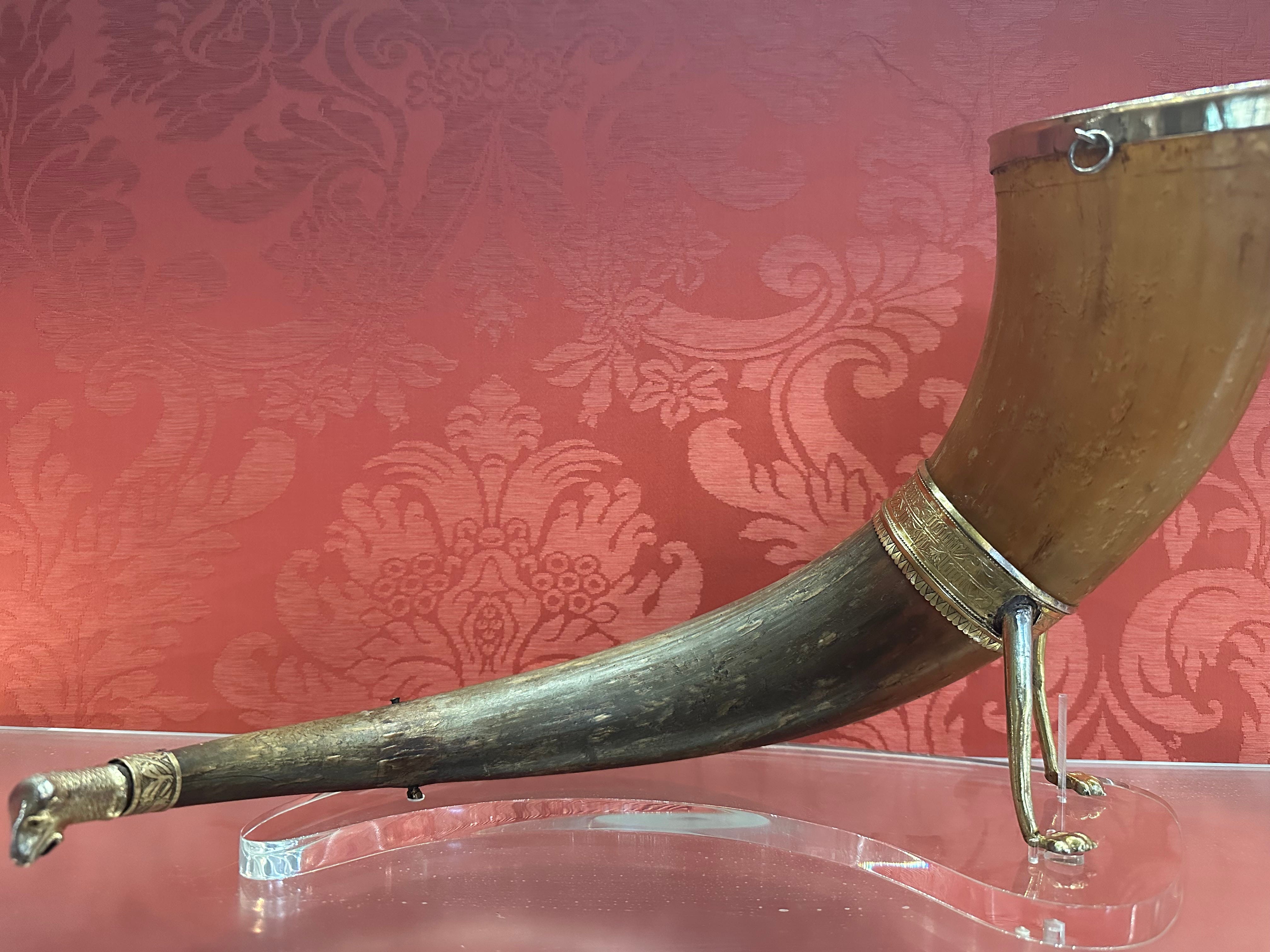
This item is an ox horn, with silver gilt decoration. You might notice that there is an inscription on the horn. This gives a clue as to why it is so unique.
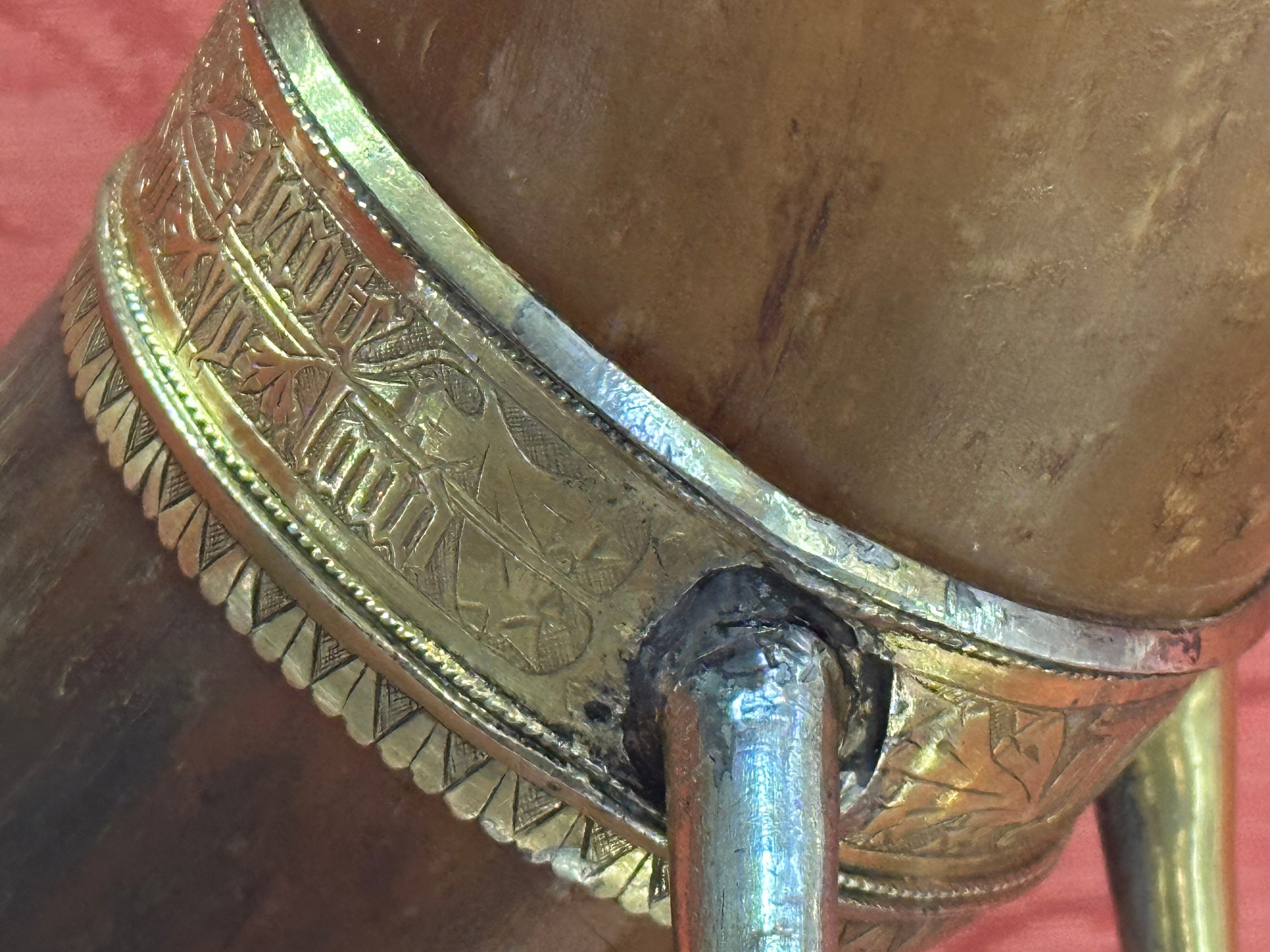
The inscription is in Middle English, dating to the 14th century. It reads: I Kynge Knowde (Canute) gave Wyllyam Pecote (Pusey) thys horne to holde by thy land. Yes, it’s the King Canute (Cnut) who told his advisors that he was not omnipotent, and could not resist the divine power of God, and therefore they should not flatter him overly. He reputedly demonstrated this by standing in the sea until the waves lapped his legs, to show his advisors that there were limits to his powers.
As my friend Edward Walker pointed out to me some time ago, however, this was no mere chattel. The horn showed that the land of the Pusey family was reputed held by the old Anglo-Saxon doctrine of “cornage”: tenure to the land was transferred by symbolic transfer of the horn itself.5
I was somewhat confused by the story that the horn had been given for warning of an impending Danish attack, as King Canute himself was King of Denmark and Norway. I wondered if there were rival Danes. However, further investigations revealed that William Pusey was a shepherd boy who warned the invading King Canute that the local Anglo-Saxons were coming, by blowing his horn, and he was given the horn and the lands as a reward.
The fight in Pusey v Pusey over who had possession of the horn therefore takes on a different complexion. It was evidently a fight between relatives over who had possession of the horn and hence possession of the land. The plaintiff was the Pusey heir, and hence it was stated that, “the Lord Keeper was of opinion, that if the land was held by the tenure of a horn, or cornage, the heir would be well intitled to the horn at law.”6 Therefore, I do not think it can be said that this was a mere chattel; it was a chattel with a right to possession of land attached. Traditionally, courts have always been willing to award specific performance of interests in land.
In any case, the report in the English Reports says, “a bill will lie for keeping undefaced, and restoring any subject of curiosity and antiquity; decreed on demurrer.” This may explain how the case became known as one which pertained to unique chattels.
The second case is Duke of Somerset v Cookson.7 The facts are intriguing. In February 1735, nine-year old Isabel Cutter, a cobbler’s daughter, found a Roman platter in the bank of the River Tyne at Corbridge, near Hadrian’s Wall. In Roman times Corbridge had been a garrison town known as Coriosopitum. Rectangular Roman platters of this kind are known as lanx. Isobel gave the lanx to her father, who then passed it on to a goldsmith, Cookson, in Newcastle. Parenthetically, it appears that a range of Roman silver items were found in the “Corbridge Hoard” between 1731 and 1760, because people sketched them, but this is the only item to survive, for reasons that follow.
The Corbridge lanx, as it is known, is absolutely exquisite. It is now held by the British Museum, and so of course, I went and found it.
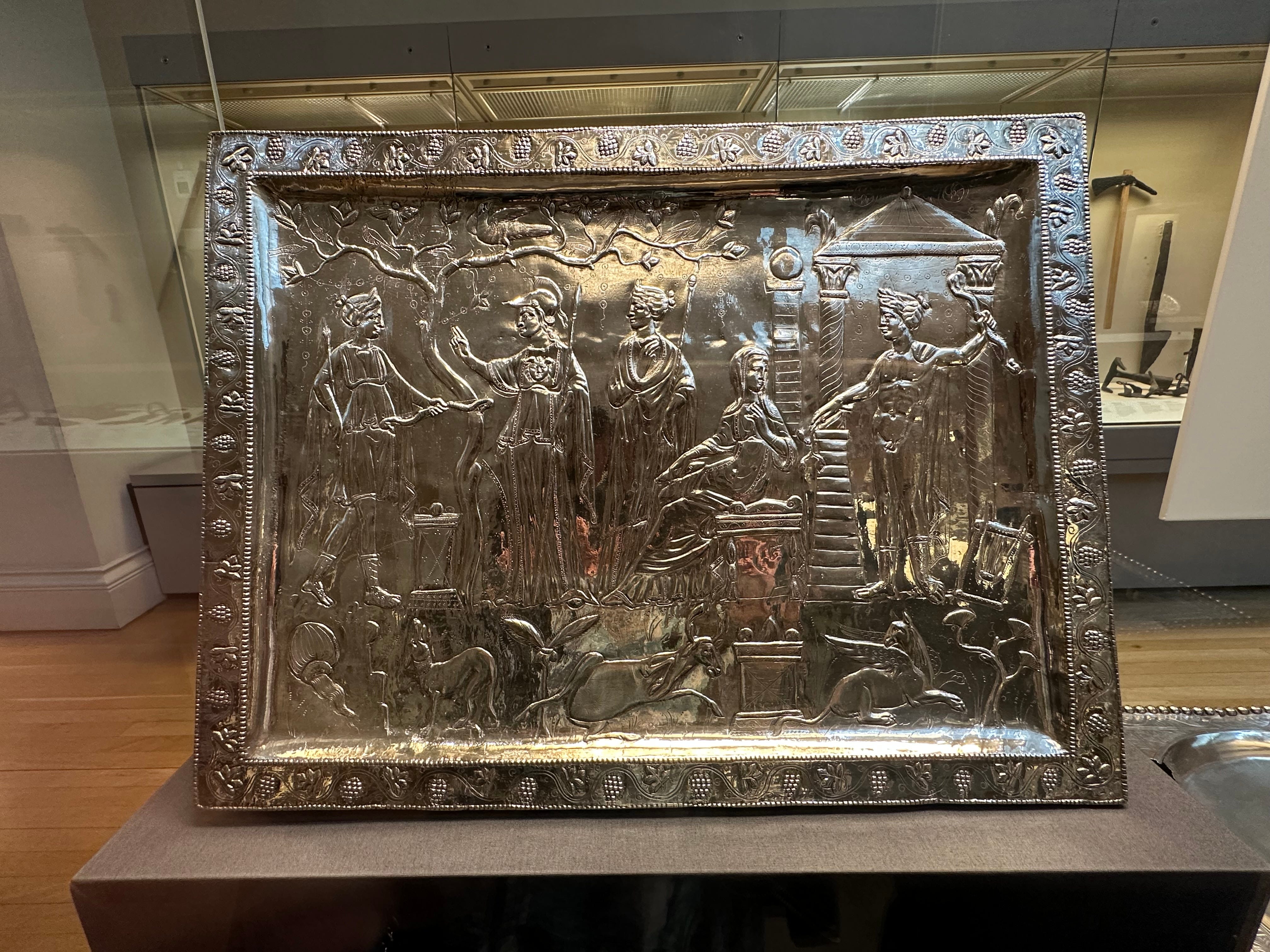
The British Museum describes it as follows:
The scene shows the god Apollo at the entrance to a shrine, holding a bow, his lyre at his feet. His twin sister Artemis (Diana), the hunter goddess, enters from the left, and the helmeted goddess with her hand raised to indicate conversation is Athena (Minerva). The two female figures in the centre are less obvious. The entire scene is clearly a shrine of Apollo. The Greek island of Delos was the birthplace of Apollo and Artemis, and Athena was also worshipped there. If the Delian shrine is depicted then the older woman sitting spinning may be Leto, the mother of the twins, and the standing woman her sister Ortygia, who was transformed into the island of Delos. In the foreground stands an altar flanked by Artemis's hound and fallen stag and a griffin, a mythical beast associated with Apollo.
The fact that this was a hoard (items hidden with an intention to retrieve later) meant that it was “treasure trove”. At common law, treasure trove had to be hidden with animus revocandi (an intention to recover it later). The fact that this was treasure trove gave the Duke of Somerset an entitlement to the item, because he owned the estate through his first wife, the late Lady Elizabeth Percy, the sole heir of the 11th Earl of Northumberland.
Cookson, the goldsmith, had notice of the Duke of Somerset’s claim in trover or conversion, but refused to relinquish the lanx. Accordingly, the Duke of Somerset brought an action for specific recovery of the lanx.
Lord Chancellor Talbot held:
the bill is to prevent the defendant from defacing the altar-piece, which is one way of depreciating it; and the defacing may be with an intention that it may not be known, by taking out, or erasing some of the marks and figures of it; and though the answer had denied the defacing of the altar-piece, yet such answer could not help the demurrer; that in itself nothing can be more reasonable than that the man who by wrong detains my property, should be compelled to restore it to me again in specie ; and the [common] law being defective in this particular, such defect is properly supplied in equity.8
In other words, the only way to ensure that that lanx was not destroyed or defaced was to order it delivered to the Duke. The lanx has now been purchased by the British Museum from the 11th Duke of Northumberland, in 1993. It was on loan to the Museum before that.
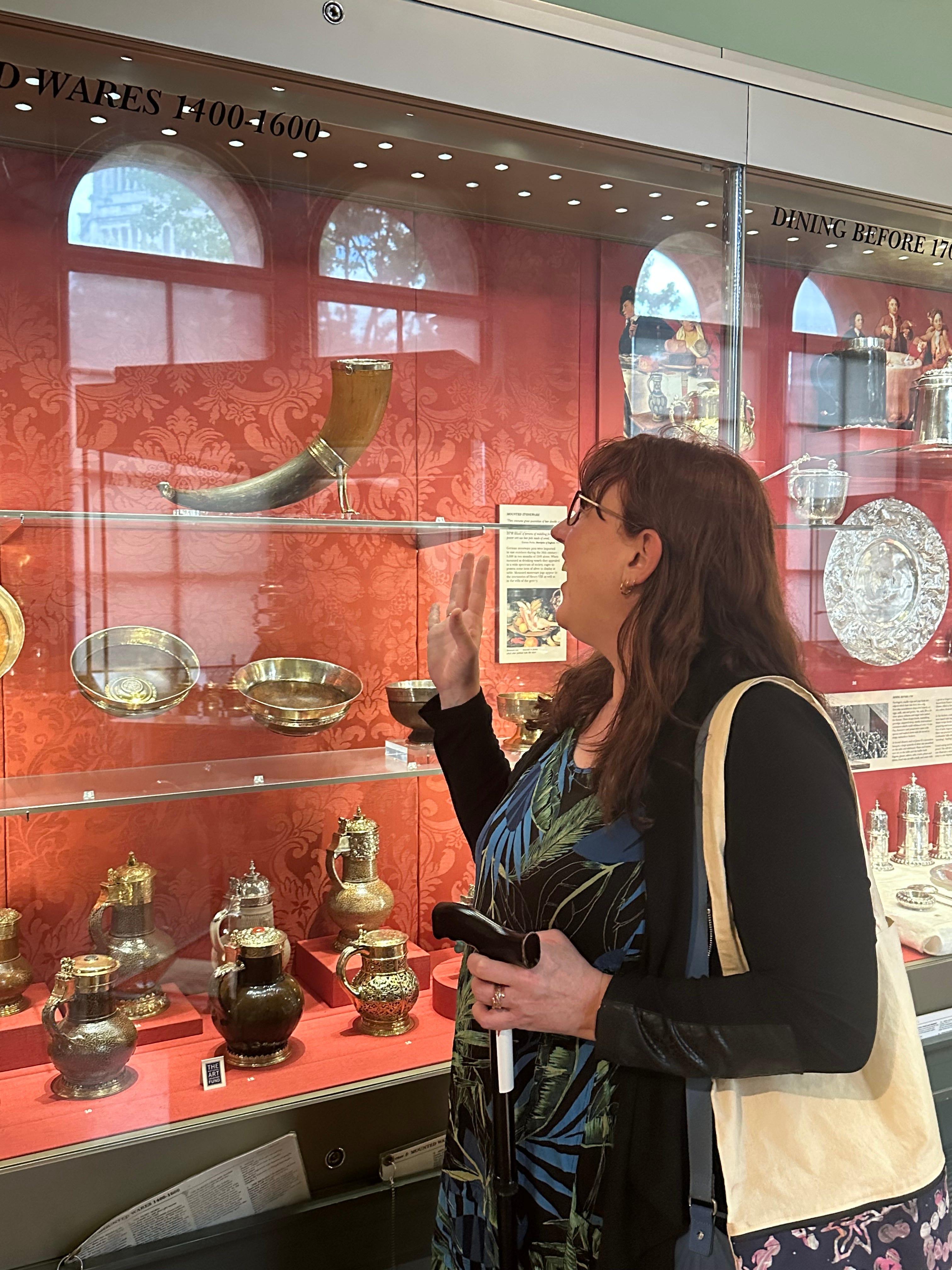
I am so glad that at least one item from this presumably beautiful hoard was preserved. Proof of my gladness is below.
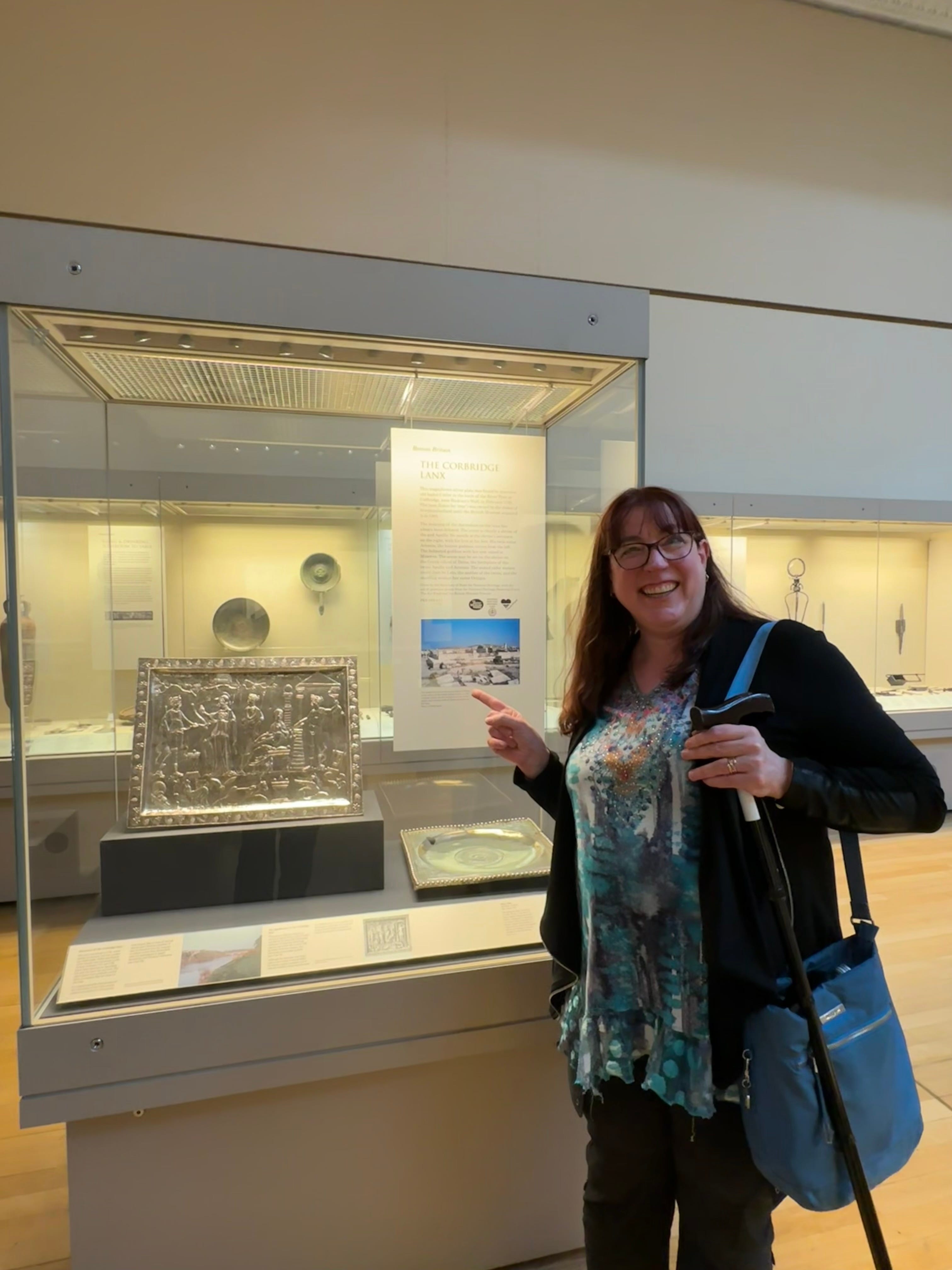
I hope you have enjoyed this journey through the early cases of specific delivery as much as I have.
Also known in the earlier cases as trover.
In the United Kingdom, the tort of detinue has been abolished and subsumed by the tort of conversion: Torts (Interference with Goods) Act 1977 (UK), s 2. However, detinue still exists in Australia.
Common Law Procedure Act 1854 (17 & 18 Vict c 125), s 78. See now Torts (Interference with Goods) Act 1977 (UK).
(1684) 1 Vern 273, 23 ER 465.
John Cherry, ‘Symbolism and Survival: Medieval Horns of Tenure’ (1989) 69 Antiquaries Journal 111.
Pusey v Pusey, above n 4.
(1735) 3 P Wms 390, 24 ER 114.
Duke of Somerset v Cookson, ibid, 391, 114.
Katy, sorry to have missed you at the Chitty on Contract conference day. But this post reminded me of how law intersects with everyday objects/places. I live in Chelmsford, Essex, and the landmark case law Parking Eye v Beavis originated in Chelmsford. Actually, near where I go to the gym! The case held that parking charges are legally enforceable, even if the fee acts primarily as a deterrent or exceeds the company's actual financial loss, provided the terms are clearly displayed and not unconscionable. There are historical objects/places that embody law, if only we look for it thoroughly! :)
I am pretty sure I did not enjoy it as much as you but I did enjoy it, thank you