

[This post was written before Jason Arday’s tragic death.]
The academy’s latest scandal is the downfall of Professor Jason Arday, formerly of Cambridge University, until he resigned recently. His own account indicated that he had overcome considerable disadvantage: he was a Black person who grew up on a council estate, he was autistic and had been non-verbal until he was eleven, and he was unable to read or write until he was eighteen.
Nonetheless, Arday completed a PhD and, eventually, became a professor. He also claimed to have suffered from a brain tumour; to have raised millions of pounds while running marathons on a broken leg, or possibly while having a fit; to have been a snooker champion at age ten; to have helped a water charity overseas; to have been on the show Seven Up; to have been sent a pig’s head…
You guessed it. As The Guardian has outlined here, all of his claims have come under question, and some of his claims have been swiftly disproven (eg, claims of visiting professorships at various institutions).
However, the core of the claims against Arday related to his scholarship. In particular, there were concerns that large chunks of his 2015 PhD from Liverpool John Moores University resembled a 2009 PhD by a scholar named Paula Zwozdiak-Myers at Brunel University—and it seemed possible that he had not in fact undertaken interviews with Black interviewees as he had claimed in some of his research. The interviewees’ words strongly matched interviews recorded in another published journal article.
A friend said to me, “But surely the ethics committee would have checked whether he undertook those interviews?” No, that’s not what ethics committees do. I have undertaken empirical research by interview. The ethics committee is more concerned that the researchers give proper consent forms to interviewees, do not dupe vulnerable people or treat Indigenous people badly, that we keep proper records, use information in ways that people consent to, and so forth. For sure, I told the ethics committee what the results of my interviews were, and gave them the citation of our chapter, but I doubt they actually checked it.
If it turns out that Arday did not in fact interview people, I’m puzzled as to why he didn’t. I had never undertaken empirical research until my co-researcher encouraged me a few years back. Ten out of ten, would do it again! We interviewed people in the offshore finance industry, about how the industry worked and why clients might wish to use a particular kind of trust. The workings of the industry and the reasons why clients wished to use such facilities were not always what we expected. Clue, it was nothing to do with taxation or tax law, contrary to what may be your first instinct.
How can this kind of research not be interesting? Why would one not want to talk to people? The answer, I suppose, is if you believe you already know the answer, and your theory trumps facts, and hence you already know that it’s not even worth talking to people. It’s a peculiar kind of arrogance: you know better than anyone else what the issue is, and so you don’t even need to consult them.
In a piece in The Telegraph, Professor Alex Edmans said:
But the real scandal is not Jason Arday. It is an entire ecosystem that wanted Jason Arday to be true. His supervisors approved his thesis, journals published his work, and Cambridge appointed him as a professor.
This, to me, gets to the heart of the matter. We live in a world where, increasingly, who you are is more important than what you do. Of course, this can incentivise some to develop extraordinary stories about their identity. I can’t help thinking of Fox Mulder’s poster in the X-Files.

It’s almost religious, a matter of faith, not rationality. If you dare to question Arday’s appointment or work or account of his life, you are presumptively racist, you do not support diversity in academia, you are “punching down” on a disabled Black person, you are part of the colonising hegemony. Everyone wants to believe, and you risk your career and reputation by raising inconvenient questions.
Indeed, someone—it’s not clear if it were Arday or his college, or the university—called the police to investigate an emeritus professor and a journalist who sought to ask questions about his work and the instances where they had found similarities to the work of other people. The journalist, Jack Grove from the Times Higher Education, wrote movingly of the toll a four-month police investigation had taken upon him, and pointed out that the fact that his piece was spiked (after threats of being sued for defamation) meant that it was so much worse when it all did come out.1 The Metropolitan Police have admitted that they responded inappropriately.
One of my friends said, “This will die away after a few weeks.” Perhaps the Arday story will. There is a part of me which feels a little sorry for Arday, despite it all. After all, as he said, he didn’t murder anyone. And if he has suffered from at least some of the disadvantages he claims, he may lack judgment. Moreover, he’s been encouraged and enabled in this behaviour by many other people over years. For his own sanity, I hope the focus on him dies off, and he finds a new passion in life, away from academia.
I might have more respect for him, however, if he acknowledged that he gave false hope to parents of a child who had autism and had undergone brain surgery.
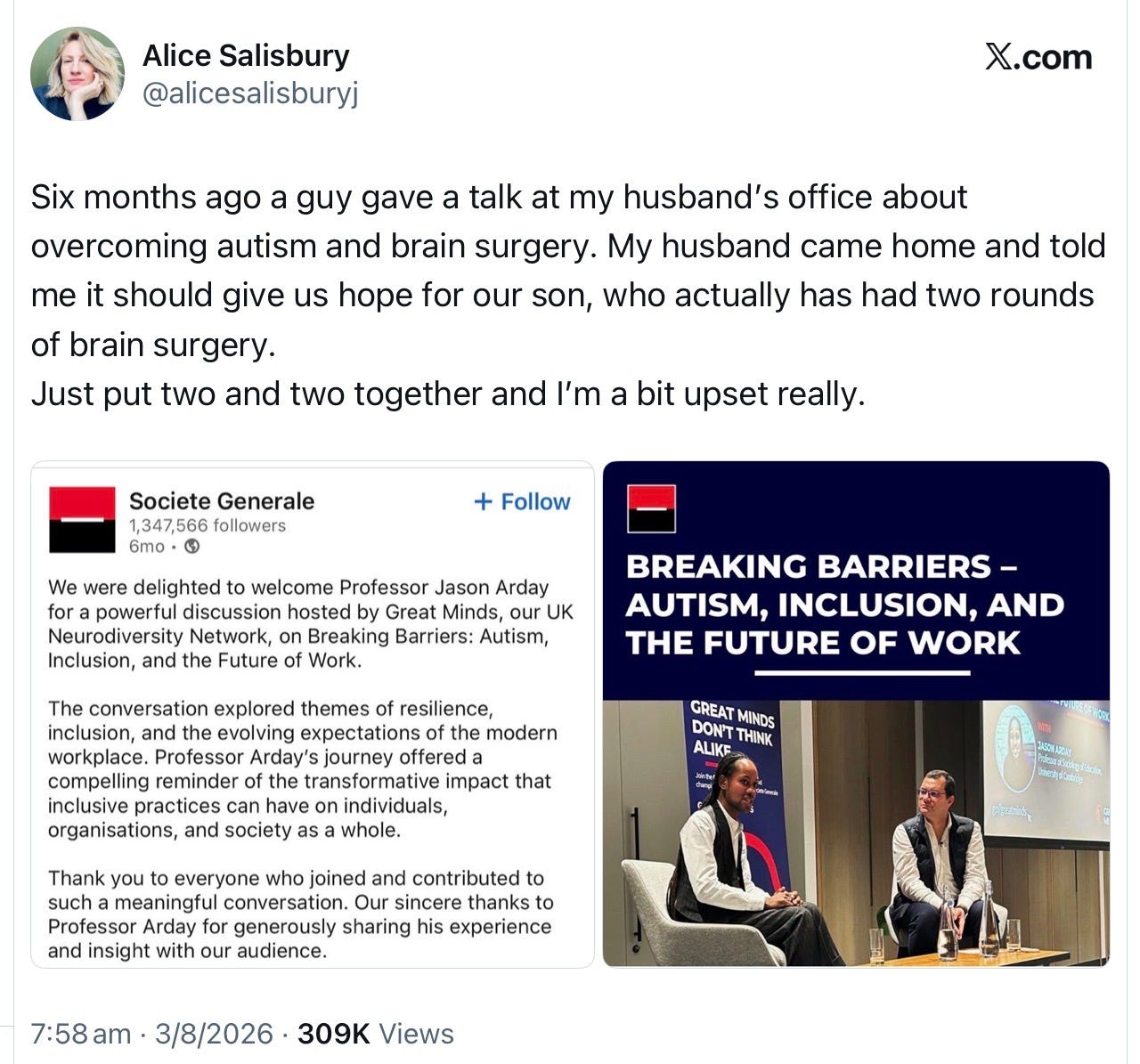
Alas, Arday’s behaviour is very much that of someone who has been told over and over, “You’re worth it, and you don’t owe anyone else anything. In fact, we owe you, simply because you have deigned to associate with us.” Indeed, when Arday was welcomed to the Faculty of Education, Professor Hilary Cremin said, “We are so lucky to have you. You are the best in the world in terms of the research that you do.”
Is it any wonder that Arday doesn’t really seem to understand how and why he has fallen? After all, until two weeks ago, he could not do any wrong in the eyes of the academy. Students complained about his conduct as a supervisor, and instead of the problems being investigated—it’s no surprise to me that someone who seems to have had a strong sense of entitlement believed that students are beneath his notice—the students were brushed off, or even accused of racism. They are now threatening to sue.
I am very angry with the academics who thought that it was a good idea to award Arday a PhD, to promote him, and to make him a Professor, when they surely must have known or suspected that some of his claims were too good to be true, and could be easily falsified. Their behaviour displays a patrician arrogance.
Arday’s appointment might make Arday’s enablers feel a righteous glow in the short term—“Look at how wonderful we are, we appointed a Black, disabled scholar!”—but when the web of falsehood disintegrates, it leads people to doubt the worth of all Black or disabled scholars more generally. It also does a disservice to all scholars and students at an institution. From what I have seen on social media, several former Cambridge graduates who had come from less advantaged backgrounds, and had worked exceptionally hard to be admitted, felt particularly betrayed.
I can understand this: they must feel that their hard work has been mocked. Instead of working so hard, why did they not embroider a story of sadness and use that instead? I, too, have felt this bitterness. Am I a fool for not using my disadvantage?
If you want to know my “lived experience” before you think I’m worth listening to, you can have it. I have suffered from cerebral palsy since birth, because I was born at 29 weeks—and yes, I have proof of this!—but I do not think that this is relevant to my academic work. My work focuses on what lawyers call “private law”—namely, the law that governs private relationships between individuals—tort, contract, equity and trusts, property, and of course, remedies.
My disability is only relevant to my work insofar as my employer must accommodate me at times because my mobility is impaired in some ways, and because I have a tendency towards pneumonia. I do not think my disability is a reason to promote me, nor do I think it is a reason why I am better than other people. It is certainly not a reason why I am more worth listening to on questions of private law. I find any suggestion of this profoundly patronising. I did not mention my disability in any of my promotion applications, until I absolutely had to (in 2018) because I was having difficulty walking more than five hundred metres and I was in constant pain. Luckily, I underwent intensive rehabilitation, and my mobility has improved out of sight.
I do not want to be pitied or treated like a kind of performing trick pony, to be brought out to show how tolerant my colleagues are: “Look at the disabled girl, aren’t we nice to her?” I want people to admire me as a scholar because I am good, not because of factors which I consider extraneous to my work. And if I’m not good, or if I make mistakes, then tell me. I’d prefer that you tell me in a way that doesn’t crush my soul entirely or publicly humiliate me, in a way that promotes constructive dialogue and knowledge, but do please tell me how I can improve.2
Just presuming that someone is worthwhile simply because he is Black and disabled and from a disadvantaged background is patronising. But so, too, is dismissing someone simply because he is Black and disabled and from a disadvantaged background. These two positions are two sides of the one coin: using a simple, superficial heuristic to decide worth, without looking at the reality.

The sole relevant consideration is does this person produce good work, and can they do what is needed? I worry that the coin may flip in society, and we’ll go to a position where women and those from minority or disadvantaged backgrounds are presumed to be worthless. If the academy continues on this path, they will produce the very thing they fear: a backlash against minorities.
Unfortunately, it is not easy to lift up people who have been profoundly disadvantaged. I tutored several Indigenous students in law, for five years. As it happens, I am part-Indigenous myself, although I did not know this at the time when I was a tutor.
One student came to me with the essay questions for their3 subject. I looked at the essays, then handed them back, and said, “Which question are you going to choose?” They said, “No, you do the essay, get an H1, then I’ll scrape through on the exam. That’s what the other tutor said to do.” I have no idea if this was true or not, but if this is true, it was profoundly wrong and unethical. I was shocked.
I told my student that they must write the essay, but that I would teach them how to research and begin writing (how to do headings, set out paragraphs and so forth). I discovered that they had a fear, bordering on pathological, of the university library. They had been thrown out of libraries in a country town because they were Aboriginal. It broke my heart. On the day I took them to the library for the first time, their whole body shook with fear. We had to stop in the doorway for this student to breathe. Their face dripped with sweat. I took them to the front desk, holding their arm tightly the whole time, and patting it. I introduced them to all the staff and I explained that they were worried that they were not welcome. All the staff assured them how welcome they were, introduced themselves, and said that they could call on staff for help at any time. I took them to the shelves, showed them how to look up the catalogue, showed them how to use the photocopier and so forth.
They were disappointed with their grade for the essay: under their own steam, they got a pass. I said to them that they should be prouder than anything of that grade. They had just proven to the world that they could write a legal essay as well as most other students (at that time about 50% of law students got pass grades). Most importantly of all, it would do them no favours if they went into practice without knowing how to do this sort of legal research, and with a grade which did not reflect their actual skills or ability.
I have no difficulty in supporting students of any race, religion or background who have not received the kind of research training that I have received, and in fact, I believe it is part of our duty as a teachers to increase people’s skills so they can reach their full potential.
I also believe it is important to support a range of people from different backgrounds to become lawyers, precisely because clients are diverse too, as long as those prospective lawyers have the ability to do legal work. If someone does not have the relevant skills they should not pass or become a lawyer. I can’t win a marathon for obvious reasons—I can’t even run these days—and some other people can’t do legal analysis. We all have different skills and abilities in life.
I also think that it is cruel to “parachute in” someone who is not suited to a role, or does not have the relevant experience, simply because they tick certain boxes. Arday increasingly seems to be an instance of this.
Now, another anecdote. A former student once told me that he wanted to quit, halfway through his law degree, because he felt like a fish out of water at law school. Yes, he was white, male and heterosexual, but I also knew he had had a very difficult and disadvantaged upbringing. I’m sorry, but if you presume that white, heterosexual men are always privileged in our society, you are closing your eyes to the reality of some people’s lives. I believed strongly that he had the ability to be a good lawyer, and that he belonged in law school as much as anyone else.
I said to him, “If your family could have consulted a lawyer about the problems you faced, who would they have preferred to consult: someone like you, or a posh guy who, while well-meaning and intelligent, may have no understanding of your situation?” His face cleared. He said, “Me.” He completed his degree successfully and I have never been so proud. I cried at his graduation. His subsequent career has vindicated my belief in him.
If universities and other institutions are going to take a “tick the box” approach to diversity, equity and inclusion, and promote people like Arday, puff people like him up with a sense of aggrieved entitlement, and refuse to investigate any questions about a person’s abilities or claims, they utterly fail to advance the position of minority groups in the academy. They are as bad as the bigots they abhor. In fact, their attitude strikes me as profoundly racist and not in the least “progressive”. The subtext is, “Black and disabled people can’t manage it, let’s turn a blind eye to any flaws and let this guy in anyway, so we can look good.”
Arday is not a freaking trophy, guys, or a tick in a box. He’s a human being. You have done a disservice to him, to the academy, your other staff and students, your former graduates, and the broader society you claim to serve.
If universities are going to punish people for asking legitimate questions, or try to shove problems under the carpet, they should also be castigated severely. The fact that questions about academic research or behaviour of academic staff are shoved under the carpet on a routine basis is a much bigger problem and goes well beyond any diversity, equity and inclusion incentives.
We need a shake-up of academic incentives more generally. At some point, things have gone badly wrong and there are deep and systemic issues. But before that shake-up happens, I suspect there will be more Ardays.
[Edited to add: It has been reported that Jason Arday died. This is utterly terrible and tragic. As I noted in the post above, I had hoped that he would find a role away from academia and all of this nonsense. I still believe that academic institutions have a lot of questions to answer—not just Cambridge but all of them.]
Disclosure: I have written for the Times Higher Education before. But then, so has Arday.
Actually, that’s one of the topics I wrote on for the Times Higher Education. I remain very committed to the idea of constructive disagreement. See Katy Barnett, ‘Other professions don’t tolerate public rudeness. Why do academics?’ in Times Higher Education (13 May 2021) https://www.timeshighereducation.com/opinion/other-professions-dont-tolerate-public-rudeness-why-do-academics
I do not want to disclose any potentially identifying features, so I will use the “they” pronoun. Unfortunately, this former student is now dead. May their memory be a blessing, and I am sure that the spirits of their ancestors have embraced them.
You wrote:
In fact, their attitude strikes me as profoundly racist and not in the least “progressive”. The subtext is, “Black and disabled people can’t manage it, let’s turn a blind eye to any flaws and let this guy in anyway, so we can look good.”
This is exactly the problem. The soft bigotry of low expectations....
As I noted in more detail in this comment elsewhere on substack - https://substack.com/profile/13379579-francis-turner/note/c-296179748
Regarding your story about visiting the library. Good on you!
Very much so.
"In a piece in The Telegraph, Professor Alex Edmans said:
But the real scandal is not Jason Arday. It is an entire ecosystem that wanted Jason Arday to be true. His supervisors approved his thesis, journals published his work, and Cambridge appointed him as a professor.
This, to me, gets to the heart of the matter." And Edmans is the right person to make this point.
Edmans also makes the important point that insane appointment like Ardayh's take away opportunities from deserving candidates.
That BBC clip featuring Arday and Cremin is cringeworthy to the max. She should be kicked out for not having done her job.